
The Hormuz Gambit
The worst policy mistake since sending Lehman into default. Maybe the worst ever.

Dear readers,
Greek historian Herodotus recorded the story of King Croesus, a man of unimaginable wealth and the last king of Lydia who lived in the 6th century BC.
Croesus was worried about the rise of the Persian empire. He considered a military campaign but consulted the famous Oracle of Delphi for advice.
The Oracle told him, if he should march against the Persians, he would destroy a great empire.
Croesus felt encouraged – but his army was defeated, and the empire which fell was his own.
Prophet Muhammad, the founder of Islam, died in 632 without a designated successor. A majority of Muslims believed his successor should be chosen from his companions and elected Abu Bakr, a close friend, as the first caliph (deputy). The group eventually became known as Sunnis, from “Sunnah”, the traditions and practices of Muhammad as interpreted by this community.
A smaller group however believed that Muhammad wished that leadership remained within his family, invoking a famous sermon of the prophet in which he designated his cousin Ali ibn Abi Talib. That group became known as Shia, from “Shiat Ali” meaning “Party of Ali”.
Both factions claimed leadership, but Sunnis initially prevailed. Civil wars followed, and leaders of both factions were murdered. In 680, a son of Ali, Husayn, started a new campaign to wrestle leadership from Sunni leader Muawiya ibn Abu Sufyan. His mission was intercepted at the city of Karbala (today: Iraq) and massacred in a brutal battle.
The Martyrdom of Karbala became a foundational myth for Shia Muslims. Husayn turned into a symbol for sacrifice and opposition to oppressive rule which Shia Muslims commemorate annually.
Operation AJAX
Iran first became a pawn of geopolitical interests in 1953, when Iranian Prime Minister Mohammad Mosaddegh nationalized the Iranian oil industry. The industry had previously been dominated by the British-controlled Anglo-Iranian Oil Company (today: BP/ British Petroleum) which was building its stake in the first global oil boom in the 1950s, a period of rapid international industrialization.

Iran was a constitutional monarchy but with a democratically elected government. To maintain western influence, the CIA together with the MI6 orchestrated Operation AJAX, a coup d’etat which removed the Mosaddegh government and strengthened the power of the Shah, who hadn’t been more than a ceremonial figure under the Mosaddegh government.
The Shah was initially viewed as a modernizer and reformer, but his power eroded soon. Not a first in economic history, the huge money that arrived from resource wealth led to bribery, embezzlement, corruption, and nepotism. As dissent with the Shah increased, he responded with brutal repression, imprisoning and torturing opponents. Economic disparity increased rapidly as wealth from oil went disproportionately to urbanites and the Shah’s inner circle. And the westernization alienated religious conservatives who saw Islamic values eroding.
Opposition groups eventually united under Ayatollah Khomeini, an exiled opposition leader. When he returned to Tehran in February 1979, the Shah’s regime was already weakened from months of violent protest across the country. The Shah fled, and Khomeini took over just days after his return. He established the Islamic Republic, a theocracy with Khomeini as the Supreme Leader.
Maximum escalation
Attacks on Iran started in the morning of February 28, 2026, with a surprise strike on the Tehran compound of Ayatollah Khamenei, Khomeini’s direct successor. It was carried out by Israeli missiles and intended to be a preemptive maneuver to remove Iranian leadership. The attack was marketed as a resounding success, as Khamenei und several other top leaders were killed. Intelligence analysts had collected ground data for months about daily routines, itineraries, and meetings of Khamenei but were still pleasantly surprised by the effectiveness of the attack.
But Iran answered with a counterstrike whose full impact still hasn’t filtered through. It attacked Saudi Arabia’s largest refinery Ras Tanura, one of the world’s biggest with an output of 550,000 barrels/ day with simple, slow drones and forced it to shut down. It destroyed a billion-dollar surveillance installation in the UAE, the THAAD radar station, supposed to monitor missiles thousands of kilometers away. It attacked U.S. military bases across the countries on the Persian Gulf, making operations on them much more difficult or even impossible.
Iran’s strategy: turn the war into a regional conflict, and thin out anti-missile defense. The U.S. only has so many rockets; the more countries they have to protect, the bigger the gaps in the shield.
On Sunday, March 1, Iran radioed an uncoded message across the seas to every vessel: stay off the Strait of Hormuz. Passage isn’t safe any longer.
Western intelligence analysts had thought that the Strait was a no-touch area for Iran to maintain goodwill with the Arab countries in the region. That belief turned out to be wrong if not naïve. Right at the time the world is transitioning to natural gas as the key carrier, Iran shut down the passageway for 25% of global LNG trade, and 20% of global oil trade. Maximum escalation had arrived much earlier than expected.
Qatar was forced to shut down production of natural gas but also intermediate and final chemical products like ammonia and fertilizers. Qatar serves mostly Asian markets, and regional gas benchmark prices jumped by 30%. European gas benchmarks (TTF/ Title Transfer Facility) have spiked by 85% in just two days.
Regime change?
The underlying goal of the U.S.-Israel coalition is to force another regime change in Iran. The strategy to get it done follows the failed template of the 1991 Iraq War. You will remember the U.S. bombed Iraq for four weeks, expecting to weaken Saddam Hussein’s regime so badly that Iraqis could finish the job themselves – Iraq was internally already divided with three competing population groups, a Shia majority, and Sunni minority, and Kurds in the north. Shias and Kurds had long been violently oppressed by Hussein who didn’t even hesitate to use biological weapons (VX nerve gas) to suppress uprisings. But despite the bombing campaign, Hussein squelched a revolution after the war before it even began.
Iran is a completely different challenge in every dimension.
Contrary to almost all Arab nations in the region, it was not created on western politicians’ drawing boards after World War I, but it has existed as a sovereign territorial entity for thousands of years – one of the oldest continuous civilizations mentioned first already in the 7th century BC.
Shia faith is characterized by its strong, central spiritual authority represented by the Ayatollah and strong hierarchies (in analogy to Christianity, Shias are the Catholics with strong spiritual leadership by the pope) – in stark contrast to Sunni Islam which is more decentralized and lacks a single religious authority. Religious scholar and local imams operate with significant authority, unthinkable for Shia Islam1.
Iran is the only major country with a Shia majority and a government which is explicitly a Shia theocracy. As a theocracy, the clergy is intertwined with bureaucracy which provided strong control of the country in the past.
No doubt, political opposition against this theo-political system has been building. Growing parts of the population believe it has failed to develop the country. The system prioritized ideological purity (brutally expressed through the IRGC and morality police) over economic and social progress, which led to new unrest and several protest waves including the January 2026 protests which resulted a in large number of casualties – the true extend is unknown. It seems that a majority of the population now favors a separation of state vs. religion, abandoning theocracy, and a democratically elected government. Those views are supported mainly by the younger and urban population. But are they prepared to go into civil war with the IRGC which is very well organized, equipped, with power structures which reach into every corner of the country? The theocracy is more deeply entrenched than most western politicians like to believe. From this perspective, the attack on Ayatollah Khamenei may actually have been counterproductive. Khamenei fully understood Israel was coming for him but still stayed in his residence. As a man of faith, in fact the most senior spiritual leader, who was he to defy Allah’s will? If his hour had come, so be it – inshallah. His death likely strengthened the resolve of traditionalists.
In Iraq, the uprising failed even though it included battle-hardened fighters especially among the Kurds, and the government represented only a minority in the country and had much less legitimacy. Regime change was brought only in 2003 and with 100,000 boots on the ground. It also resulted in the forever wars.
Energy prices
Make no mistake, we’re looking at the biggest disruption in oil supply ever. If the war keeps going even for only a few weeks, the impact will be much larger than in previous episodes of price shocks like the embargoes in the 1970s.
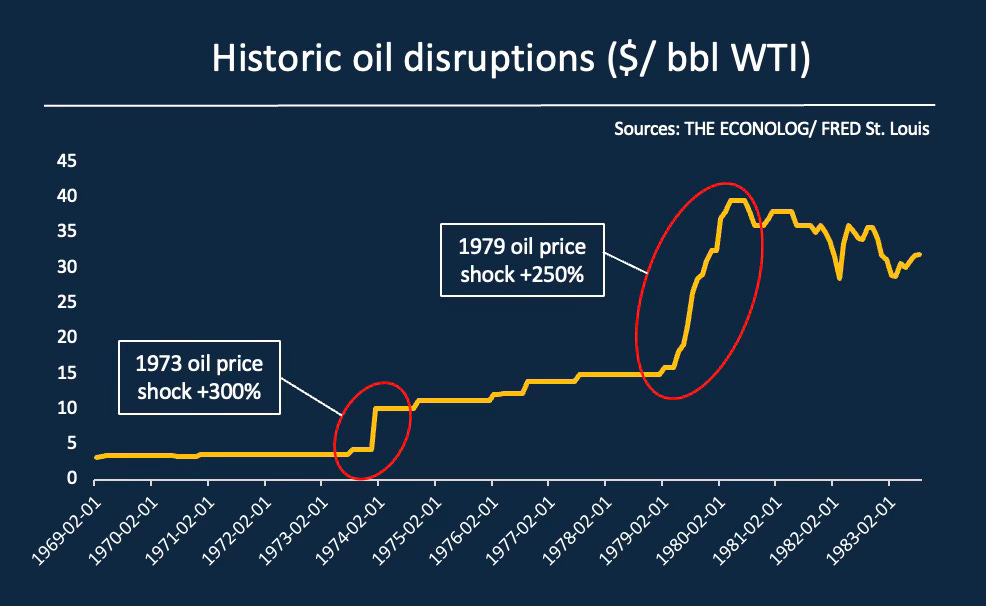
The rise in the last three days (+20% of key benchmarks like WTI and Brent) reflected a “war premium” (heightened uncertainty) but no supply disruptions. Once strategic reserves are depleted, which will happen in a few weeks, oil prices will start climbing by much more. Just projecting prices based on the experience of the 1973 and 1979 embargo shocks (+300%/ +250%) will result in prices of $200/ barrel2.
If the Strait remains shut, they might go much higher. The world economy cannot deal with a 20% decline in oil supply. The Strait of Hormuz has become the most critical asset in the conflict. Who controls the Strait controls the outcome of the war.
The question now is, what can the U.S. do to gain control?
On March 3, Donald Trump put out a Truth Social posting ordering the United States Development Finance Corporation (DFC) to provide insurance to tankers crossing the Strait (regular insurance companies don’t provide cover any longer in the region). He also said the Navy would provide escorts for safe passage.
How is the Navy supposed to provide cover to dozens of tankers daily? The Navy has 12 warships in the region. They have made sure to stay out of reach of Iran’s missiles (which are believed to have a radius of up to 300 kilometers). Crossing the Strait would bring them to a distance of 30 kilometers or less to Iran’s coast. It’s very easy for Iran to saturate the defense capabilities of a single ship or even a small convoy, especially considering there’s almost no lead time for countermeasures. Iran has spent at least 20 years building hidden, fortified missile launch bases along the coast.
Trump’s idea isn’t more than a desperate hipshot. The worst thing about his post? It’s reactive. It demonstrates the U.S. has lost the strategic initiative, only four days into the war.
Scenarios for the endgame
In a hardline scenario, Iran’s position is pretty straightforward: sit out Israeli/ U.S. bombing for a few more weeks and watch how oil stocks in the rest of the world are depleting. Even the U.S. is at risk, because its refineries are calibrated for Middle East oil qualities. Japan is 90% dependent on Middle East oil after turning off the Russian tap. Western countries will beg for peace negotiations which will largely follow Iran’s terms.
Minimum viability scenario: Iran will allow some traffic through the Strait in exchange for deliveries of critical supplies into the country, taking off pressures on both sides. But it will prolong the war with attrition on both sides, and a disadvantage building on the Iranian side.
Forced opening of Hormuz: the U.S. pries open the Strait. The chances of success are essentially zero.
Winners/ Losers
Winners:
The U.S. energy industry becomes the only global low-risk super producer.
Vertically integrated energy companies like Exxon, Chevron, ENI
Russia, which sells oil at higher prices and sees much higher demand
Losers:
Consumers worldwide
Asian energy importers incl. India, China, and Japan
Ukraine, as air defense systems/ restocking get diverted to Israel
Europe, the biggest loser suffering the biggest price increases because of massive imbalances in its energy sector.
The decision to go to war with Iran was a huge mistake. It failed to consider a crucial escalation scenario and to define a clear off-ramp – what is the U.S. definition of success, and how can it get out? If there’s residual sanity left, the war will probably end with a humiliating retreat of the U.S., the end of sanctions against Iran, and higher risk premiums for energy products for several months. King Croesus is a classic example of hubris and the danger of misinterpreting warnings.
Let me know what you think,
All the best,
John
This is one of the reasons why George W. Bush’s “Axis of Evil” (Iraq, Iran, North Korea) never made sense – communicating reasons for terrorist attacks based on quotes and interpretations of scripture is impossible for Shias. The only authority to interpret scripture is religious leadership.
Let’s add another consideration to create a worst-case scenario. As I’ve pointed out many times, ample-reserve regimes since the GFC have created huge amounts of excess liquidity.

That liquidity is shopping around for the best investment returns – from mag-7 technology stocks, over private credit, to gold and silver, each market going through price changes and liquidity flows previously considered impossible. As energy prices start rising, the same mechanisms might kick in again: hedge funds, speculators, index investors, large money pools like pensions and insurance companies looking for diversification, all of them pushed into coordinated action by a new flywheel. The cycle will work best when physical delivery is restricted, as it is now. That scenario, sure, is based on a war over several weeks, the Strait of Hormuz remaining closed, and speculation kicking in – in sum not exactly a base case for events, but not really a tail event either.
This is an existential war for Iran. It is a proud nation with a history going back to over 5000 years. On top of it you have the Shia muslim effect with talks of an end of time battle. For the Iranians this is the end of time. They understand that the US and Israel want to totally destroy them, destroy their country, steal what they can, destroy everything including their identity. This is existential for them. They understood this decades ago and they started planning for it and they’ve planned and planned. They are not stupid.
There is this tendency in the West to see the rest of the world as lacking agency, as stupid. It is a tendency based on 500 years of Western domination of the planet. That archetype has lead the US into a very very stupid war that has the potential to be the most disastrous war in American history. They’ve committed now instead of walking away. Iran’s current strategy is to deplete US anti missile munitions and then bring out the big missiles. If this plays out Israel will be massively bombed which will force the two countries to do something massively foolish like either carpet bomb Tehran or nuke it. Will Iran give in? I do not think so. This will end up in chaos in the middle eastern countries as restive populations get angry and force their countries to do something. Pressure on Trump but he’s an idiot.
What’s Russia and China’s role in it? I think they knew part of the plan and have helped the Iranians. For China it’s critical that the US does not defeat Iran because this would mean the US now controls most of the major oil in the world apart from Russia. They can squeeze China, use the leverage to get better deals and impose their will on China. This could end up being existential for China and could end up in war with China similar to how Japan ended up declaring war on the US. For Russia they understand that this is also existential because the West would love to smash Russia into pieces. My take is that they are playing a waiting game. They expect the war to get out of control and break out into a major war pitting the Europeans/Israelis/US vs Iran and maybe Yemen. Any invasion would have to involve bombarding which would kill lots of civilians and cause an outcry that would 'force' Russia and China to step in either as mediators or worst case, as participants
We do not know what the Iranians have planned but we know they’ve had many years to plan for it and they are not stupid and they intend to punch a massive blow that will change the Middle East forever. They must have done this simulations, thought through this possible situations. I suspect that Russia, China and Iran may have led the US into a trap in order to force a new worldwide magna carta to avoid WW3. It’s obvious that the current rules are not working and without some limit on the powers of the US, this world will end up in a world war. A major nation cannot be going around toppling other countries, kidnapping leaders, assassinating leaders at will. There has to be some major crisis that forces the world leaders to sit down and work out a code of conduct else WW3 becomes a very strong possibility
For the US this is a race for the continuation of world domination. If they can crush Iran and impose their will on it they’ll get extra leverage against China who will now be their next target to try and topple. China will be a different matter especially if they get a breakthrough in chip manufacturing. The US has gone into an existential war either by luck or by a genius cunning. They will be forced to go all out on Iran because their ego cannot let them back down. Iran is now the US's new Vietnam and this time, there's the internet and social media for the world to see and record for posterity.
This is also a fight between Shia and Sunni Islam and Sunni Islam is reeling and will be bleeding for a long time. Muslim youth all over and especially in the Middle East and Europe will be seeing a Shia spiritual leader who martyred himself for a greater cause. On the other hand there's no Sunni equivalent, just filthy rich Sunni leaders who lead a wasteful decadent life while claiming to be pious. I would not be suprised if the Shia faith grows in the coming years, the growth made worse by Sunni leaders fighting the inevitable the only way they know how; violence.
Essential reading thanks John.
The disruption in the medium sour crude flows to the Southeast Asian refineries is already threatening New Zealand's energy security.
As you rightly note this is moving beyond being just a shipping logistics issue in the Strait of Hormuz, to becoming a structural issue as refineries and pipelines are attacked. The timelines are all extending by months with each passing day.
The world is far more interconnected than it was in the 70's. This complexity makes things far more fragile. The implications of energy flows becoming severely restricted will manifest in ways we cannot imagine let alone respond to in a coherent manner.