
How to Cut CO2 Emissions
Hint: Not the way leading transition countries in Europe do it

Dear readers,
Europe remains fully committed to industrial policies which reduce carbon emissions. Costs for electrical power have risen, and negative externalities are showing up more frequently. In April, Spain’s electrical grid faltered, pulling down Portugal as well. Germany’s grid has gone through several near-death experiences and had to be bailed out by neighboring countries. Politicians in Nordic countries have threatened (more theatrics than anything else) to cut connections to the German grid to avoid the spill-over of price volatility created by German shortages.
So it’s a fair question – was it all worth it? Have Spain and Germany, Europe’s leaders in the renewable-energy transition, successfully reduced their overall carbon emissions? Have they become the poster boys whose policies lead the way for other countries? Time to take a closer look!
A lot of research and data crunching went into the paper – hope you like it! I’m pretty sure you haven’t seen those data and charts anywhere else. If they are interesting and helpful, please leave me a ‘like’, share, and comment! And if you haven’t signed up already – why not consider a subscription? It really helps me keep going.
While Europe, proverbially speaking, is cutting itself off an arm and a leg to drive down carbon dioxide emissions, other global countries are powering ahead with installations of new power generation capacity based on fossil fuels. Indonesia recently announced to add 20 gigawatts of captive coal capacity over the next 7 years (power for specific industrial plants, not for the electrical grid). China has installed coal capacity at record pace. In 2024 alone, China started building 94 gigawatts of coal capacity. Those numbers are mind-boggling, and to put them into perspective: the average grid load in Germany is around 55-60 GW – China therefore added 50% more capacity than total Germany demand, in a single year, just in coal.
Coal is the most carbon-intensive source of energy. Because of China’s massive expansion of its power plant fleet, China has long become the leading emitter of CO2 emissions, with little signs that emission growth is slowing.
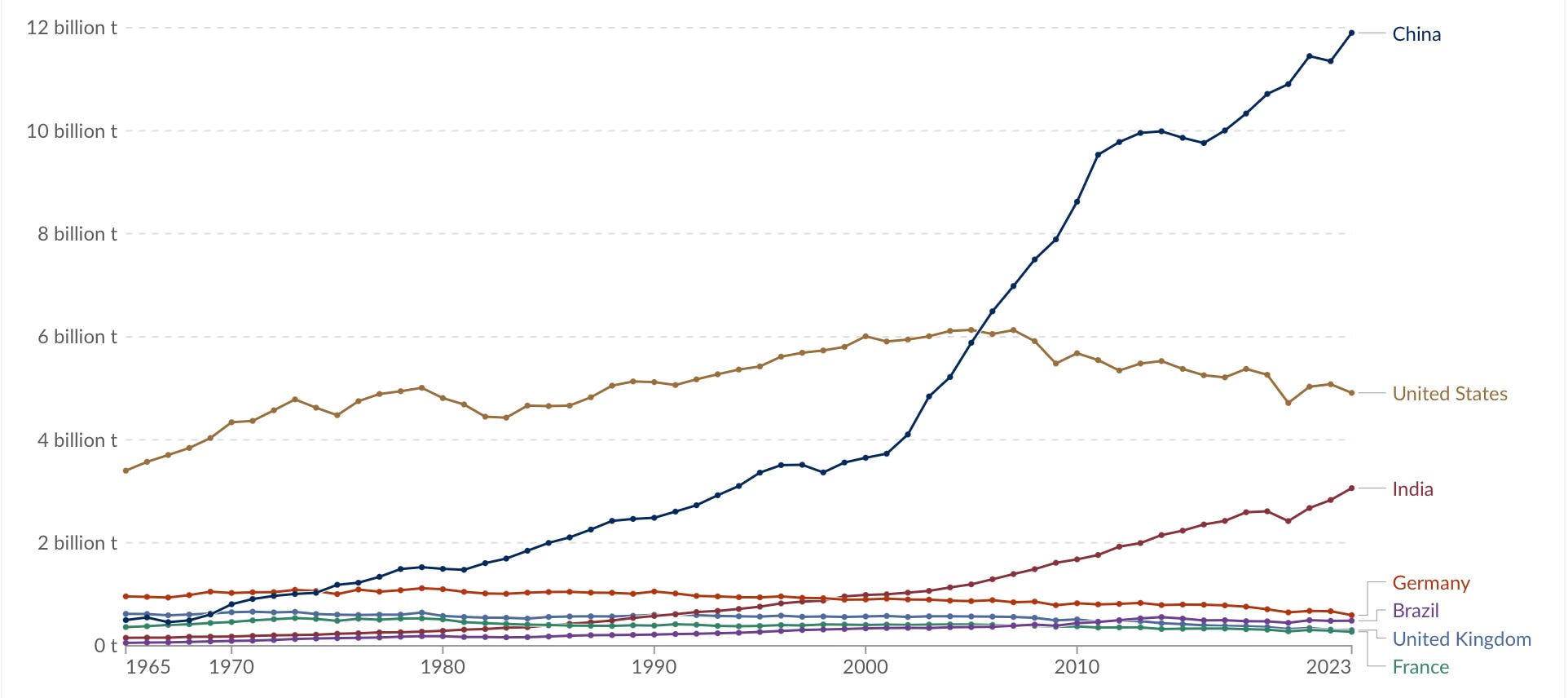
(Source: Global Carbon Budget 2024/ Our World in Data)
Keep reading with a 7-day free trial
Subscribe to The Econolog to keep reading this post and get 7 days of free access to the full post archives.